https://www.nofer.co.uk/


This month´s PROMOTIONS

Eye wash station inspection checklist: weekly and annual checks

2 Nov 2026

An emergency eye wash station only helps if it works the moment someone needs it. Valves seize, caps go missing, water in the pipework goes stale and units end up hidden behind pallets. A short weekly check, plus a fuller inspection once a year, prevents all of that.

This guide sets out what to check, how often, and what to record. You can copy the checklists below into your own maintenance log.

Why regular checks matter

  • Reliability: a valve that has not been used for months can stick or leak when it is finally opened.
  • Water quality: water left standing in pipework can become contaminated. Flushing it through every week keeps the supply fresh. HSE guidance on Legionella control (HSG274 Part 2) also includes emergency showers and eye wash sprays among the outlets that should be flushed regularly.
  • Evidence: if there is an accident, a dated inspection record shows the equipment was maintained.

ANSI/ISEA Z358.1, the standard most widely used for the installation and maintenance of emergency eye wash equipment, recommends activating plumbed units weekly and inspecting all units annually.

Weekly eye wash station checklist

This takes about two minutes per unit. Run it on the same day each week and sign it off.

Check What good looks like
Access Nothing blocking the route or the unit. It can be reached in about 10 seconds from the hazard.
Signage and lighting Safety sign clearly visible. Area well lit.
Dust covers Caps in place and they pop off when the unit is activated.
Activation Valve opens in one movement and stays open without being held.
Flushing Run until the water is clear (allow at least 3 minutes after a long period of no use).
Flow Both nozzles flow evenly, with a gentle stream that would not hurt the eyes.
Leaks and damage No drips after closing. Basin, nozzles and pedal or lever undamaged.
Record Date, unit location, result and initials on the inspection tag or log.

Annual eye wash station inspection

Once a year, a competent person should carry out a fuller check against the standard. In addition to the weekly points:

  • 15-minute flow test: the unit delivers a continuous flow for at least 15 minutes. ANSI Z358.1 sets a minimum of 1.5 litres per minute for eye wash units and 75.7 litres per minute for emergency showers.
  • Water temperature: tepid, between 16 and 38 °C. Very cold water stops people rinsing for long enough.
  • Installation height: eye wash nozzles between 838 and 1,346 mm from the floor, and at least 153 mm from the nearest wall or obstruction.
  • Location: still within about 10 seconds of every hazard, on the same level, with no doors or stairs in the way. Check again after any change to the layout or to the chemicals in use.
  • Spare parts: replace worn seals, damaged covers or a sticking valve. Spares are available for all NOFER units.

Portable eye wash stations

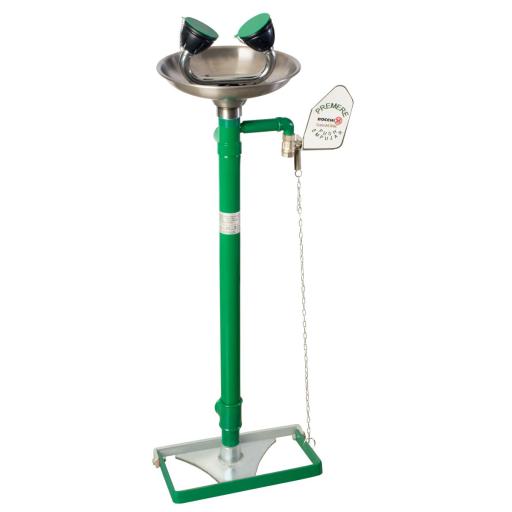
Self-contained units such as our portable emergency eye wash station have no mains supply to flush through, so the weekly check is different:

  • Check the tank is full and the seal or tamper tag is intact.
  • Check the pressure gauge, where fitted, is in the green zone.
  • Change the water, or the water and preservative, at the interval the manufacturer gives, and record the date on the unit.
  • Test the flow at each refill, with the unit on a drain or bucket.

What to do if a unit fails

Take it out of service with a clear sign, point staff to the nearest working unit and make sure that is still within reach of the hazard. If there is no alternative, stop the work that creates the risk until the unit is repaired. Most faults on a plumbed unit are a worn valve seal or a blocked nozzle, both quick to fix with the right spare part.

Choosing a unit that is easy to maintain

A unit that is easy to test gets tested. Look for:

All NOFER emergency eye wash stations and showers are tested to EN 15154 and ANSI/ISEA Z358.1, and spare parts are available for every model. See the full range of emergency eye wash stations and safety showers.

Need a recommendation for your site? Send us the substances involved and a rough layout, and we will suggest the right units. Get a trade quote.

This guide is general information to help you plan inspections. It does not replace your own risk assessment or the instructions supplied with your equipment.